
regional housing needs allocation (rhna)
The RHNA process refers to the first two steps (Determination and Allocation) of a multi-step proces
Since 1969, California has required that all local governments (cities and counties) adequately plan to meet the housing needs of everyone in the community. This process starts with the California Department of Housing and Community Development (HCD) determining how much housing at a variety of affordability levels is needed for each region in the state. Then the regional governments develop a methodology to allocate that housing need to local governments. California’s local governments then adopt housing plans (called housing elements) as part of their “general plan” (also required by the state) to show how the jurisdiction will meet local housing needs.
How are these numbers calculated?
HCD is responsible for determining the regional housing need for each region's planning body.
existing conditions report for housing downtown
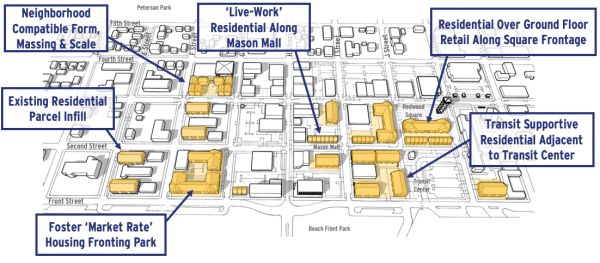
As part of the Downtown Specific Plan, an Existing Conditions Report was completed by Johnson Economics and Crandall Arambula. The report notes that downtown residential development is essential for a revitalized downtown. The presence of downtown residents help animate the public realm throughout the day and during all seasons, providing passive ‘eyes on the street’ security, and customers for downtown businesses. To support downtown commercial services, a minimum of 1000 downtown residences within a half mile radius of the centroid of the downtown is needed, based on Crandall Arambula’s experience. In August 2025 there were only 206 downtown residential units, far below an adequate number to support existing businesses. Infusing meaningful amounts of new, mixed-income housing units will require concerted efforts to identify sites where housing is viable— parcels of adequate size or sites that can be assembled to efficiently accommodate higher density apartments or condominiums. As a result of the Existing Conditions Report, Crandall Arambula has identified a need for 400-600 additional housing units in the downtown corridor, which can be referenced in the Downtown Specific Plan - Phase I document.